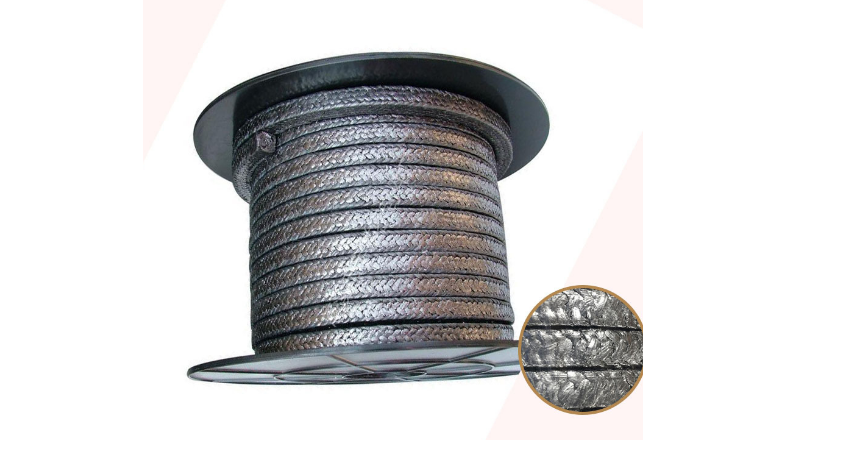


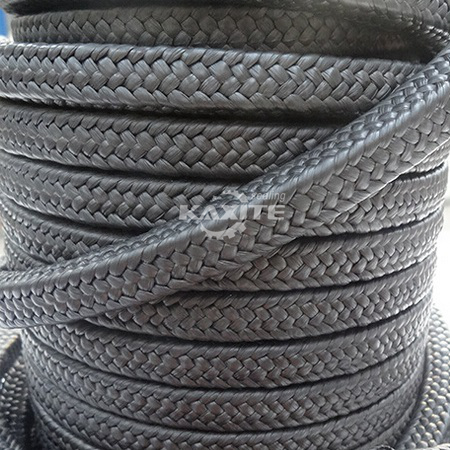
Graphite PTFE Filament Packing
Model:KXT P203
KXT P203 graphite PTFE filament packing is braided from sintered high-stretch graphite PTFE multifilament yarns, impregnated with PTFE dispersion and graphite powder for high structural density and cross-sectional density. The dense construction resists compression and extrusion at 200 bar static, 100 bar reciprocating and 25 bar rotary, runs at 25 m/s, and covers -150 to +280 °C and pH 0–14 at 1.65 g/cm³. Best specified for slower shaft speeds on rotary equipment, reciprocating pumps and valves handling a wide range of industrial media.
Style KXT P203 · Sintered Graphite PTFE Filament Braid
Graphite PTFE Filament Packing KXT P203: What It Is, Where It Fits, and Why Buyers Specify It
Graphite PTFE filament packing KXT P203 is braided from sintered, high-stretch graphite PTFE multifilament yarns and impregnated with PTFE dispersion and graphite powder. The dense, dimensionally stable result holds 200 bar static, 100 bar reciprocating and 25 bar rotary, runs at 25 m/s, and covers -150 to +280 °C and pH 0–14 at 1.65 g/cm³. It is the style buyers specify when a pump or valve needs reliable compression and extrusion resistance at slower shaft speeds, with good thermal conductivity and long service life.
- 200 barStatic sealing
- 25 m/sRotary speed
- -150 / +280 °CTemperature range
- 1.65 g/cm³Density
Braided from sintered graphite PTFE multifilament yarn
KXT P203 graphite PTFE filament packing starts with sintered, high-stretch graphite PTFE multifilament yarn rather than a conventional PTFE fibre. That is the reason the density reaches 1.65 g/cm³ — the highest in the graphite PTFE packing family — and the reason the packing keeps its cross-section under gland load. The yarn is then impregnated with PTFE dispersion and graphite powder to close up the interstices, raise density further and lift sealing efficiency.
Buyers comparing this style with a standard braided graphite PTFE should know the difference: a filament construction is chosen for dimensional stability and low cold flow, not for maximum shaft speed. KXT P203 is specified where compression set, extrusion and short service life are the problems being solved. Review the graphite PTFE packing range for the parent family, or the pure graphite PTFE packing if pure graphite content is the deciding requirement.
Why graphite PTFE filament packing resists compression and extrusion
Compression set and extrusion are the two failure paths that shorten a packing's life in slow-speed pump and valve service. KXT P203 addresses both by pairing a dense, sintered filament yarn body with a PTFE dispersion and graphite powder impregnation. The graphite powder improves thermal conductivity so frictional heat is carried away from the shaft instead of building at the contact face. The impregnation fills voids, so the packing cannot cold-flow into the clearance gap under gland load.
The result is a packing that keeps its cross-section, keeps gland load where it belongs, and holds a stable seal for longer intervals between repacking. It also carries the excellent lubricity that graphite brings, which is why KXT P203 graphite PTFE filament packing runs cooler and with less shaft wear than a dry PTFE braid. The trade-off is shaft speed: KXT P203 is intended for slower shaft speeds, and higher-speed rotary duties are better served by the graphite PTFE packing with aramid fiber corners. For an overview of every construction by duty, see the full braided packing catalogue, and the PTFE packing page if chemical resistance rather than mechanical strength is the primary selection criterion.
Where KXT P203 graphite PTFE filament packing is used
Advantages of KXT P203 graphite PTFE filament packing
-
Higher density, higher sealing efficiency
PTFE dispersion and graphite powder impregnation push density to 1.65 g/cm³, the highest in the graphite PTFE packing range.
-
Compression and extrusion resistance
The dense, sintered filament body resists cold flow into the clearance gap and keeps the cross-section stable under gland load.
-
Best at slower shaft speeds
KXT P203 graphite PTFE filament packing is specified for slower shaft speeds, where its dimensional stability and long life count most.
-
Long service life, lower repacking cost
Stable cross-section and low compression set translate into longer intervals between repacking and lower maintenance labour.
-
Good thermal conductivity
Graphite powder carries frictional heat away from the shaft, reducing glazing and shaft wear at the contact face.
-
Excellent lubricity
Graphite content lowers break-in and running friction compared with a dry PTFE braid, easing installation and shaft loading.
Technical data — KXT P203 graphite PTFE filament packing
| Parameter | Condition | Rating |
|---|---|---|
| Pressure | Rotary pump | 25 bar |
| Reciprocating pump | 100 bar | |
| Static sealing | 200 bar | |
| Rotary speed | — | 25 m/s |
| Density | — | 1.65 g/cm³ |
| Temperature | — | -150 °C to +280 °C |
| pH value | — | 0 to 14 |
Frequently asked questions about KXT P203
- What pressure rating does KXT P203 graphite PTFE filament packing hold?Up to 200 bar for static sealing, 100 bar for reciprocating pumps and 25 bar for rotary pumps, at shaft speeds up to 25 m/s.
- Is KXT P203 suitable for higher shaft speeds?No. KXT P203 graphite PTFE filament packing is intended for slower shaft speeds. Higher-speed rotary duty is better served by graphite PTFE packing with aramid fiber corners.
- What temperature and pH range does KXT P203 cover?-150 °C to +280 °C and pH 0 to 14, with a density of 1.65 g/cm³.
- What sizes are available?Coil form as standard, and die-formed rings cut to the shaft diameter, stuffing box bore and depth on request.
- Can I get a factory-direct quotation and a sample?Yes. Kaxite supplies OEM and MRO buyers directly from its Ningbo factory with quotations, dimensional drawings and sample evaluation.
What to send with your KXT P203 enquiry
- Packing cross-section in mm, or ring dimensions for die-formed rings
- Shaft or stem diameter, stuffing box bore and depth
- Process medium, concentration and whether solids are present
- Operating pressure, temperature and shaft speed
- Equipment type — centrifugal pump, reciprocating pump, valve stem or agitator
- Quantity per size, delivery schedule and any inspection or documentation requirement
Request a quotation for KXT P203 graphite PTFE filament packing
Send your gland dimensions, medium and operating conditions — the technical sales team will confirm suitability and reply with pricing, lead time and a sample offer.
Send Inquiry
Contact Info
-
Address
No. 432 Zhenhai Middle Road, Luotuo Street, Zhenhai District, Ningbo City, Zhejiang China
-
-
Email
Request a Quote or Technical Consultation
Share your sealing requirement and our technical sales team will respond within 24 business hours. For fastest service, include your flange specification, operating pressure, temperature, and process media in the message below.


News Recommendations