

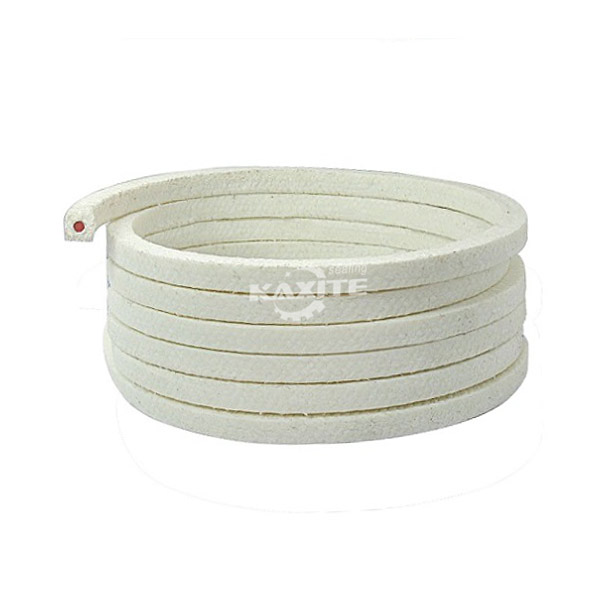
Graphite Spun Aramid Fiber Packing
Model:KXT P303
KXT-P303 is a graphite-impregnated spun aramid braided packing — the shaft-safe alternative to standard Kevlar packing. Graphite impregnation adds solid lubrication and heat conduction, allowing use on standard-hardness shafts where KXT-P302 (spun Kevlar) would require 60 HRC. Static sealing 250 bar, reciprocating pump 150 bar, rotary pump 40 bar, rotary speed 20 m/s, service temperature −100°C to +280°C, pH 2–12, density 1.4 g/cm³. Specified for abrasive slurry, chemical and solvent service where shaft hardness cannot be guaranteed. Custom cross-sections and pre-cut rings to drawing or sample; factory-direct pricing within 24 business hours.
What is graphite spun aramid fiber packing? Graphite spun aramid fiber packing is a braided gland packing made from aramid (Kevlar) fiber yarn that has been impregnated with graphite before braiding. The aramid fiber provides the abrasion resistance and tensile strength; the graphite impregnation adds solid lubrication, heat conduction and gap-extrusion resistance. Kaxite KXT-P303 is a shaft-safe grade — 250 bar static sealing, 150 bar reciprocating pump, 40 bar rotary pump, −100°C to +280°C, pH 2–12, 1.4 g/cm³ — and does not require the 60 HRC shaft hardness that standard Kevlar packing (KXT-P302) does.
KXT-P302 (Spun Kevlar) Requires 60 HRC shaft Pure Kevlar — highest abrasion resistance but will damage a softer shaft. For shafts already hardened to 60 HRC.
KXT-P303 (This page) Shaft-safe — no 60 HRC requirement Graphite-impregnated Kevlar — self-lubricating, no shaft damage. Pressure ceiling is lower, but soft shafts are no longer a barrier.
The choice between KXT-P302 spun Kevlar and KXT-P303 graphite spun aramid comes down to one question: is the shaft 60 HRC or harder? If yes, pure Kevlar gives the highest abrasion resistance and pressure ceiling. If no, graphite-impregnated aramid is the correct grade — the graphite acts as a solid lubricant that prevents the aramid from scoring a softer shaft, at the cost of a lower pressure ceiling (250 bar vs 300 bar static; 40 bar vs 80 bar rotary). For pure graphite without aramid fiber, see graphite packing; for Kevlar without graphite impregnation (hard shaft required), see spun Kevlar packing.
Graphite Spun Aramid Fiber Packing Specifications, Pressure Ratings and Factory Quote
The data below covers the standard KXT-P303 configuration. Note that the pressure limits are lower than KXT-P302 — the graphite impregnation is what trades some pressure capacity for shaft safety. Include the cross-section, shaft hardness (HRC if known), stuffing box depth and quantity in the enquiry for accurate pricing and lead time.
Static Sealing 250 bar
Reciprocating 150 bar
Rotary Pump 40 bar
Rotary Speed 20 m/s
Temperature −100°C
to +280°C
to +280°C
pH Range 2 – 12
Density 1.4 g/cm³
Shaft Requirement Shaft-safe
(no 60 HRC)
(no 60 HRC)
 Aramid (Kevlar) yarn impregnated with graphite before braiding — provides shaft safety + heat conduction + gap-extrusion resistance.
KXT-P303 vs KXT-P302 vs Pure Graphite Packing — Selection by Shaft Hardness and Media
Three grades are often compared in the same enquiry: KXT-P302 (spun Kevlar, hard shaft required), KXT-P303 (graphite-impregnated aramid, shaft-safe), and pure graphite packing (no aramid, high-temperature steam). The comparison below gives the selection decision for each combination of shaft hardness and media.
| Criterion | KXT-P303 (This page) | KXT-P302 | Pure Graphite Packing |
|---|---|---|---|
| Shaft hardness requirement | None — shaft-safe | 60 HRC minimum | None specified |
| Static sealing pressure | 250 bar | 300 bar | Up to 480 bar (valve) |
| Abrasion resistance | Excellent (graphite-lubricated aramid) | Excellent (pure aramid) | Good |
| Heat conduction | Very good (graphite + aramid) | Moderate | Excellent |
| Max temperature | +280°C | +280°C | +650°C in steam |
| Best for | Abrasive slurry / chemical / solvent on soft shafts | Abrasive slurry on 60 HRC+ shafts | High-temperature steam, valve stem, no abrasion |
Selection rule in one sentence: abrasive media + hard shaft (60 HRC+) — KXT-P302; abrasive media + soft or unknown shaft hardness — KXT-P303 (this page); high-temperature steam without abrasion — pure graphite packing. The pressure difference between KXT-P302 and KXT-P303 (300 vs 250 bar static) is the price of shaft safety — if the shaft can handle Kevlar, KXT-P302 is the stronger grade; if not, KXT-P303 is the correct grade and the pressure ceiling is what it is.
Where KXT-P303 Is Specified — Soft-Shaft Abrasive, Chemical and Solvent Service
KXT-P303 is specified where the media is abrasive and the shaft hardness cannot be guaranteed at 60 HRC. The four application clusters below cover the majority of real KXT-P303 demand.
| Application | Typical Duty | Why KXT-P303 |
|---|---|---|
| Slurry, sand and grit pumps on standard-hardness shafts | Rotary up to 40 bar; pH 2–12 | Graphite lubrication eliminates shaft scoring — Kevlar's abrasion resistance without the 60 HRC requirement |
| Abrasive chemical pumps (OEM pump builds) | Static up to 250 bar | Works with the standard 316L or duplex stainless shaft that most chemical pump OEMs supply |
| Solvent and oil pumps with abrasive contamination | Reciprocating up to 150 bar | Media otherwise PTFE-compatible but contains abrasive particles from the process — graphite holds the particles away from the shaft |
| High-pressure industrial pumps with long service cycle | Static 250 bar, +280°C | Graphite impregnation prevents gap extrusion under high temperature and pressure — long service life |
KXT-P303 is not the correct grade for every packing application. For shafts confirmed at 60 HRC or harder, KXT-P302 gives a higher pressure ceiling. For high-temperature steam above +280°C, graphite packing is the correct grade. For clean chemical service without abrasion, graphite PTFE packing is often more economical. For the base aramid grade without graphite impregnation, see aramid fiber packing.
Why the Graphite Impregnation Matters — Shaft Safety, Heat Conduction and Extrusion Resistance
The difference between KXT-P302 and KXT-P303 is not cosmetic — it changes three mechanical behaviours that matter in service. Each one traces back to the graphite impregnation.
| Behaviour | With Graphite (KXT-P303) | Without Graphite (KXT-P302) | Engineering reason |
|---|---|---|---|
| Shaft friction | Low — graphite acts as solid lubricant, no scoring | High — aramid fiber can score softer shafts | Graphite's lamellar crystal structure forms a low-shear slip plane |
| Heat dissipation | Very good — graphite conducts heat efficiently away from the shaft | Moderate — aramid conducts heat less efficiently | Graphite thermal conductivity ~5 W/m·K vs aramid ~0.04 W/m·K |
| Gap extrusion under pressure | Resisted — graphite-filled matrix is dimensionally stable | Also good, but with a higher pressure ceiling | Graphite filler reduces matrix compressibility |
| Service life on high-pressure pump | Long — graphite-impregnated matrix resists cyclic degradation | Long on hard shafts only | Continuous self-lubrication reduces frictional heat build-up |
Procurement note: the shaft-safe claim is valid for standard industrial shafts — typically 316L, duplex stainless, or carbon steel in the 20–35 HRC range. It is not a claim for coated or specially hardened shafts, and it does not eliminate the need for correct installation (progressive gland tightening, break-in procedure, correct stuffing box clearance). Confirm the shaft material and hardness in the enquiry so Kaxite can confirm the recommendation.
Factory Supply, Custom Cross-Sections and Bulk Quote Requirements
KXT-P303 is manufactured at Kaxite's Ningbo facility and supplied factory-direct for OEM, MRO, project and distribution procurement. Standard cross-sections are held for fast shipment; custom cross-sections, custom lengths and pre-cut rings to the exact stuffing box height are made to drawing or sample. For buyers consolidating a packing package across different media, KXT-P303 can be combined with KXT-P302 spun Kevlar, graphite packing and aramid fiber packing in a single shipment, so the same plant can standardise on the correct grade per machine.
To quote accurately, include: cross-section (mm or inch), shaft diameter and shaft material / hardness (HRC if known), stuffing box depth (for pre-cut rings), total length or number of rings, supply format (rope / pre-cut rings / continuous spool), operating media (slurry, chemical, solvent, etc.), operating pressure, operating temperature and quantity. The technical sales desk returns pricing, lead time and material certification scope within 24 business hours.
Send your specification →
Send your specification →
Send Inquiry
Contact Info
-
Address
No. 432 Zhenhai Middle Road, Luotuo Street, Zhenhai District, Ningbo City, Zhejiang China
-
-
Email
Request a Quote or Technical Consultation
Share your sealing requirement and our technical sales team will respond within 24 business hours. For fastest service, include your flange specification, operating pressure, temperature, and process media in the message below.



News Recommendations